
The Copper Chokepoint
The “electrify everything” mandate has run into a hole in the ground.
Copper connects generators to grids, grids to data centers, batteries to motors, and factories to the wider economy. Demand can change with policy and technology. Supply remains governed by ore bodies, water, permits, communities, capital, and time.
That asymmetry is the chokepoint.
Under the Cascade Thesis, the chain runs from AI and electrification → grid expansion → copper demand → declining grades and slow mine response → refining concentration and geopolitical competition. The future shortage is not guaranteed. The pressure required to avoid it is already real.
A Gap With Assumptions
S&P Global’s 2026 study projects total copper demand rising from 28 million tonnes in 2025 to 42 million tonnes in 2040. In its constrained-supply case—without meaningful new mine, recycling, and substitution response—the modeled shortfall reaches 10 million tonnes by 2040 [1].
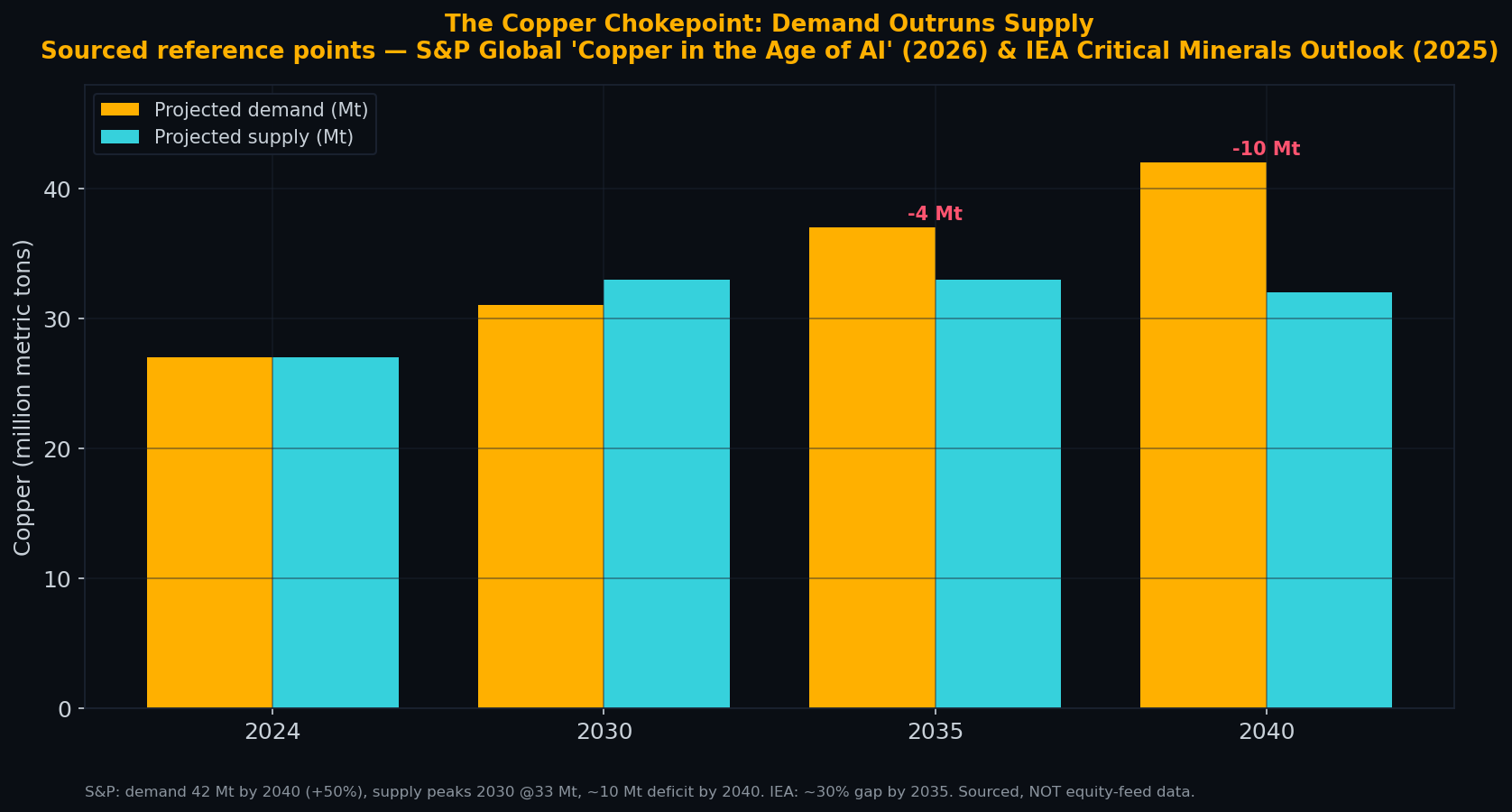
The 2040 gap is a modeled constrained-supply scenario, not a known outcome. Prices, substitution, recycling, permitting, and new projects determine how much of it survives.
The IEA reaches the same bottleneck from another direction. Based on the current project pipeline, it sees a potential copper deficit of about 30% by 2035 [2]. It also reports that average global mine grades have fallen roughly 40% since 1991 and that discovery-to-production takes about 17 years.
Lower grades are not an accounting detail. They mean moving and grinding more rock for each tonne of metal. That raises energy, water, labor, tailings, and capital requirements. The resource does not vanish; its marginal cost moves upward.
This is why “demand minus existing supply” is the wrong mental model. High prices trigger responses. The relevant question is whether recycling, substitution, efficiency, and project development can arrive before concentrated demand collides with slow infrastructure.
The Processing Chokepoint
The mine is only the first bottleneck. Concentrate must be smelted and refined.
The IEA estimates China supplied roughly half of global smelter output in 2025 and accounted for more than 90% of global smelter-output growth since 2005 [2]. That concentration gives the West a second problem: securing ore without securing processing does not create an independent supply chain.
This is why copper strategy now includes railways, ports, power plants, trade finance, and diplomacy. The ore body is embedded in a system.
Zambia and the Corridor
The Central African Copperbelt contains some of the world’s most important expansion potential. Zambia has set an ambitious goal of lifting annual production toward 3 million tonnes by 2031, while attracting capital to existing districts and new discoveries [6].
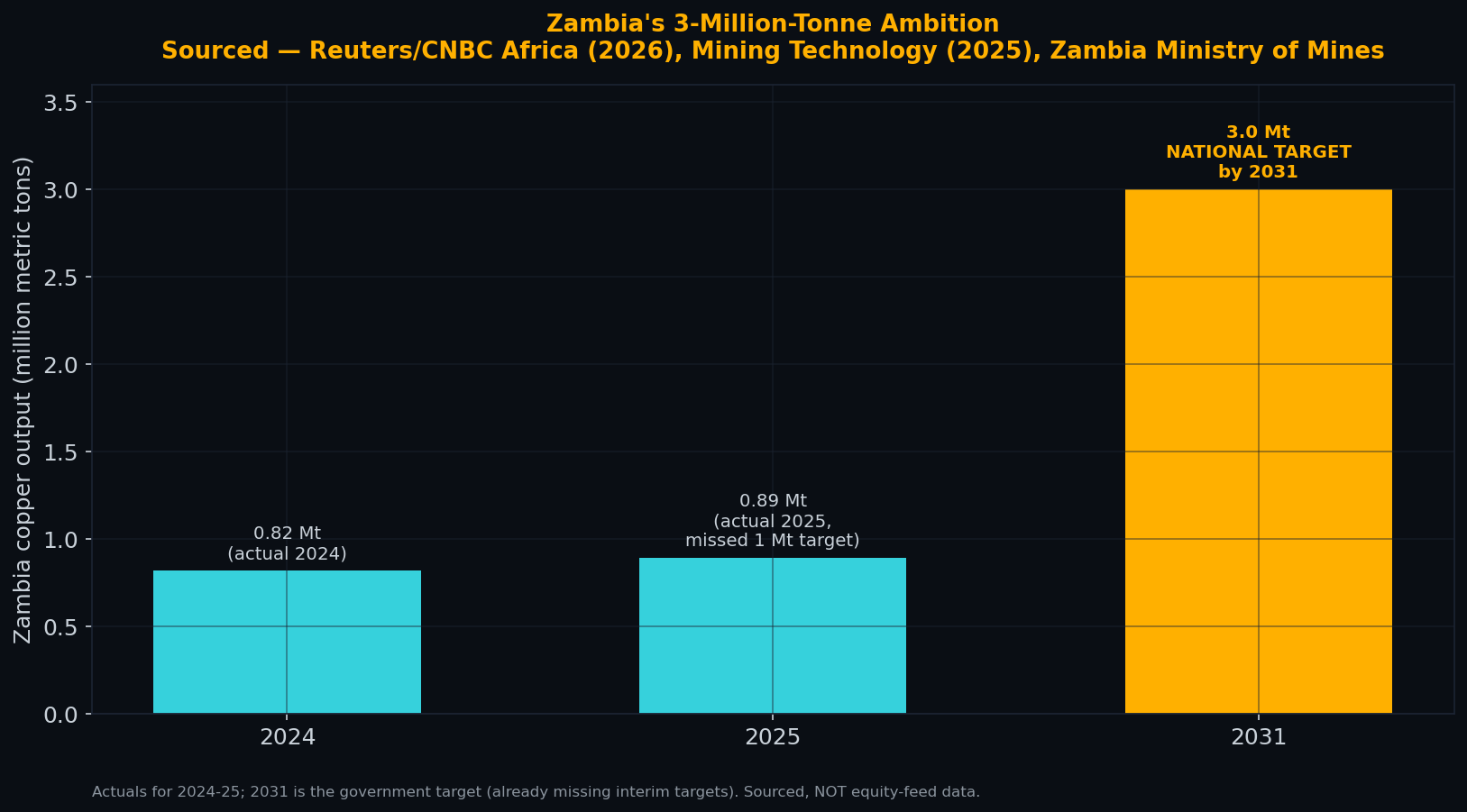
The 2031 figure is a national target, not a production forecast. Power, water, regulation, financing, and execution determine whether the path closes.
The attraction is obvious: existing mining knowledge, large deposits, and a government seeking investment. The constraints are equally concrete. Zambia has missed prior output goals, its electricity system is heavily exposed to hydrology, and mines require reliable power long before new tonnes reach export markets.
The Lobito Corridor is the geopolitical response. Rail and port investment linking Angola’s Atlantic coast with the Democratic Republic of Congo and Zambia could diversify transport away from routes and processing networks dominated by China. It will not turn geology into instant supply. It could change who finances, moves, and ultimately controls the metal.
This is supply-chain policy expressed in steel and concrete.
The Exposure Map
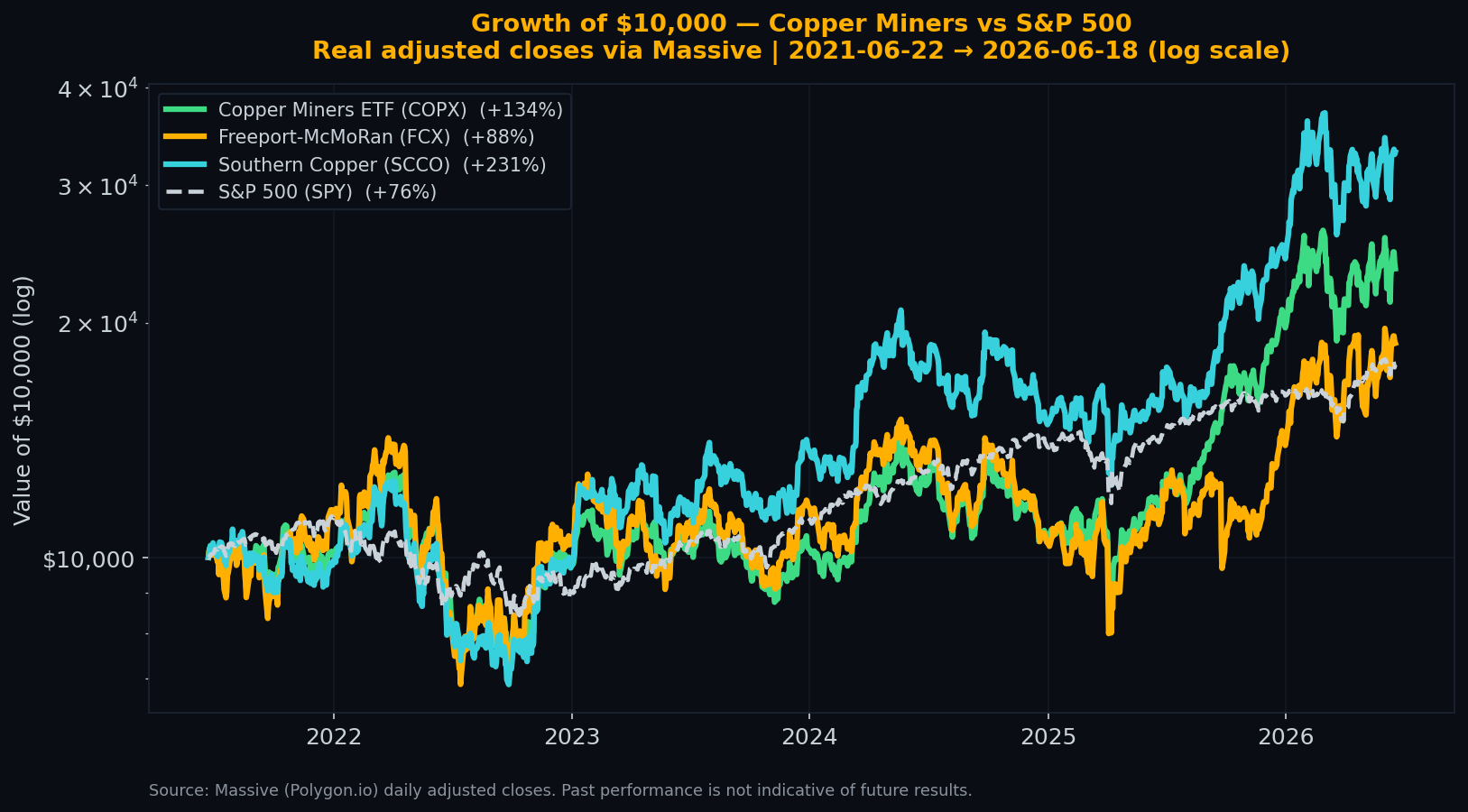
Copper equities offer operating leverage to the metal and expose investors to mine-level, country, cost, and equity-market risk. The chart uses adjusted prices through its stated cutoff.
Freeport-McMoRan (FCX) offers scale across the Americas and Indonesia. Its portfolio provides leverage to copper prices, but the company’s filings also describe long permitting cycles, large capital commitments, political and social risk, and water-right litigation affecting Arizona operations [3]. Water is a constraint, not the sole driver of the business.
Southern Copper (SCCO) combines long-lived assets with concentrated exposure to Peru and Mexico. Its risks include copper cyclicality, labor concentration, environmental obligations, politics, energy, and water. The company states its current sources are sufficient and continues to invest in water recovery; the thesis should not be misread as an assertion that SCCO faces an immediate shortage [4].
Global X Copper Miners ETF (COPX) spreads company-specific risk across 40 global miners. As of September 2026, its largest holdings were each roughly 4–5.5%, with SCCO and FCX near 5% apiece [5]. It is still a miners-equity fund—not spot copper—and retains country, currency, operating, and market risk.
First Quantum and other Copperbelt operators offer more direct regional exposure, but also bring higher jurisdiction, balance-sheet, and project-execution risk. A strategic asset can still be a poor security at the wrong price.
The Counterforces
The deficit is a scenario, not a prophecy.
At high prices, aluminum substitutes for copper in overhead lines and some cables. Manufacturers reduce copper intensity. Scrap collection improves. Projects that were uneconomic become financeable. Demand can also disappoint if EV adoption, grid spending, China, or AI infrastructure slows.
Those forces matter. But they work unevenly. Aluminum requires bulkier designs where space and thermal performance matter. Recycling depends on old metal becoming available and cannot supply a system that is still expanding. New mines face the same permitting, water, power, and community constraints that created the problem.
The deep-sea option remains regulatory and technological optionality, not bankable near-term supply. The amount of nodule material on the ocean floor should not be confused with recoverable contained copper, nor with permitted, economic production.
Copper does not need to reach a 10-million-tonne shortfall for the chokepoint to matter. The investments, substitutions, and political bargains required to prevent that gap are the thesis.
You cannot print copper. But high prices can change how much the world uses, recycles, and is willing to dig for. The opportunity—and the risk—lives in that contest.
References
[1] S&P Global, Copper in the Age of AI: Challenges of Electrification (2026)
[3] Freeport-McMoRan, SEC filings
[4] Southern Copper Corporation, SEC filings
[5] Global X, “Copper Miners ETF (COPX)” — holdings and disclosures
[6] World Bank, Copper Mining in Zambia (2026)
This article is for informational and educational purposes only. It is not investment advice, a recommendation, or an offer to buy or sell any security. The author may hold positions in securities discussed. See the site’s full Disclaimer & Securities Disclosure.
Liquidity & size of the names above
Data as of 2026-06-26 · Massive/Polygon, last ~30 trading days · figures move daily
Real figures from market data (2026-06-23 (last ~30 trading days)). Size tiers reflect median daily dollar volume — how easily a position can actually be entered or exited. This is reference data, not a recommendation.
Liquidity, in plain terms: how easily you can get in and out. Deep means you can trade freely without moving the price; Thin means even small orders can move it — mind the spread.
What this does not tell you — valuation. A real structural deficit does not mean the price hasn’t already discounted it. These figures show size and tradeability only; we deliberately do not screen for valuation, solvency, or whether a name is cheap or expensive today. Do your own valuation work.
| Ticker | Name | Type | Market cap | Median daily $ vol | Liquidity |
|---|---|---|---|---|---|
| FCX | Freeport-McMoran Inc.~80% of revenue is copper; gold (Grasberg) and molybdenum are byproducts. Largest US-listed copper pure-ish play. | Stock | $98.7B | $879.0M | Deep |
| SCCO | Southern Copper CorporationOne of the purest copper majors (Peru/Mexico), but ~88% owned by Grupo México — low free float, controlled-company governance risk. | Stock | $161.0B | $248.4M | Deep |
| COPX | Global X Copper Miners ETF (NEW)Pure copper-miner ETF, ER 0.65%, ~$8B AUM, 41 holdings; globally diversified (KGHM, Teck, BHP, First Quantum, Antofagasta) — FCX/SCCO each only ~5%. | ETF | n/a · ETF | $337.7M | Deep |
Tiers: Deep ≥ $100M/day · Liquid $20–100M · Moderate $3–20M · Thin $1–3M · < $1M = execution risk. The note under each name is a sourced exposure disclosure (how pure or diluted the play is), not a valuation view. Source: Massive/Polygon aggregates, last ~30 trading days (snapshot 2026-06-26). Figures move daily.
Found this useful? AtomProphet is independent and reader-funded — you can support the research & hosting ↓
Get the next cascade in your inbox
One short email when a new analysis drops — a single constraint traced end to end, from the physics to the chokepoint to the tickers, with the honest bear case kept in view. No marketing, no tracking, no noise.
- One email per published analysis — typically a few a month, never a daily blast
- The full cascade: driver → chokepoint → vetted, live-liquidity tickers
- The counter-case spelled out, not buried
No account, no paywall. Double opt-in, and one-click unsubscribe in every email.
Support the research & hosting
AtomProphet is independent, ad-light, and reader-funded. Contributions help cover data feeds, hosting, and the time behind the Cascade Graph — they keep this research free and open. A tip buys nothing, unlocks nothing, and is not payment for advice or for any security mentioned anywhere on this site.
Bitcoin37h98hpiHz6BW6ELvRLagk7BBo8UUtxeSh USDC · Base 0x1ac1Abe9eCAd5fAd8fF55B188E079b52cD1e6415