
The Northern Pivot: The Arctic Opens as the Politics Close
The ice is retreating faster than the institutions around it can adapt.
That is the central contradiction of the Arctic. Climate change is making northern routes, resources, and land more accessible. At the same time, sanctions, militarization, weak infrastructure, permafrost damage, and ecological risk are making the region harder to finance and operate.
The physical corridor is opening. The political corridor is closing.
Under the Cascade Thesis, that collision matters more than any simple “Arctic boom” story. It creates demand for icebreakers, ports, surveillance, resilient construction, insurance, and logistics—but it does not hand investors a clean ticker.
The Ice Signal
The Arctic has warmed nearly four times faster than the globe since 1979 [1]. NOAA’s 2025 Arctic Report Card recorded the lowest winter sea-ice maximum in the 47-year satellite record. The September minimum was the tenth-lowest, and its extent was 28% below 2005 [2].
The quality of the ice has changed as well. Multiyear ice—the thicker ice that survives summer—was 47% less extensive than in 2005, while ice older than four years had nearly disappeared [2]. That does not produce an ice-free commercial highway. It produces a younger, more variable system with a longer navigation season and persistent operational danger.
“Less ice” is not the same as “easy water.” Moving ice, poor charts, limited rescue capacity, darkness, weather, and high insurance costs remain decisive.
The Route That Is Open—and Not Open
The Northern Sea Route runs along Russia’s Arctic coast. Its operator says the route can reduce distance to many European ports by roughly 30–40% compared with the Suez route [3]. That saving is route-specific, and distance is only one component of cost.
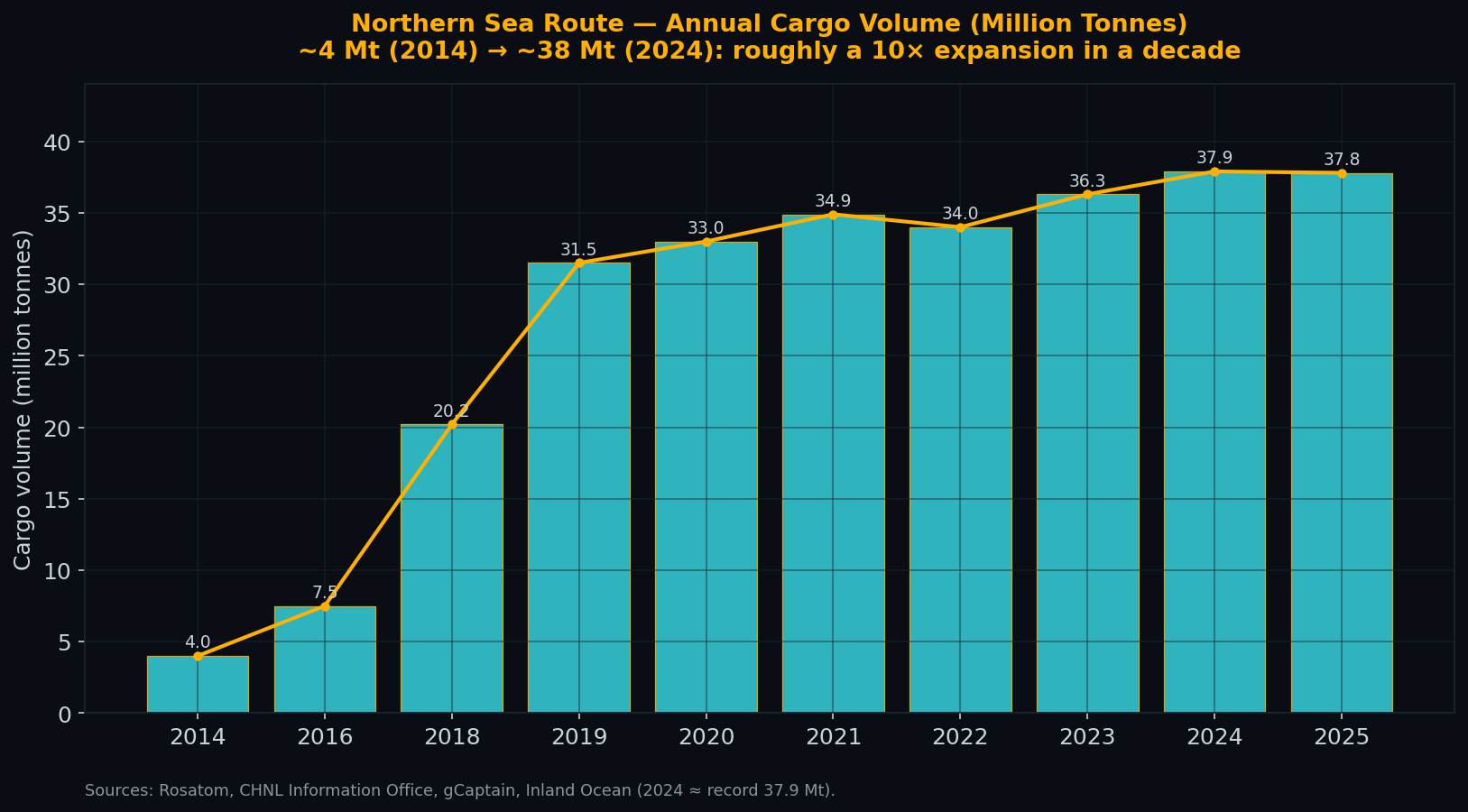
Observed cargo grew dramatically from 2014, reached a record in 2024, and remained near that range in 2025. Most volume is destination traffic tied to Russian projects, not Asia–Europe transit.
Rosatom reports 37.02 million tonnes of total NSR cargo in 2025, down from the 2024 record. Transit cargo—ships using the route as a through-corridor—was only 3.2 million tonnes [3]. The distinction matters. A busy Russian resource corridor is not yet a replacement for Suez.
Geopolitics narrows the route further. Russia controls the coast, permits, icebreaker support, and much of the infrastructure. Sanctions constrain vessels, financing, technology, and cargo. Russia’s eight operating nuclear icebreakers demonstrate formidable physical capability; they also underscore who controls access [3].
The investable conclusion is not “buy Arctic shipping.” It is that northern logistics are becoming strategically important before they become commercially simple.
The Frontier Is a Scenario, Not a Farm
Warming also changes where crops can grow. A 2026 study in Communications Earth & Environment modeled new late-century climatic suitability for seven crops across northern regions. It estimated 4.86 million km² of new frontier under a lower-emissions scenario and 11.64 million km² under a high-emissions scenario [4].
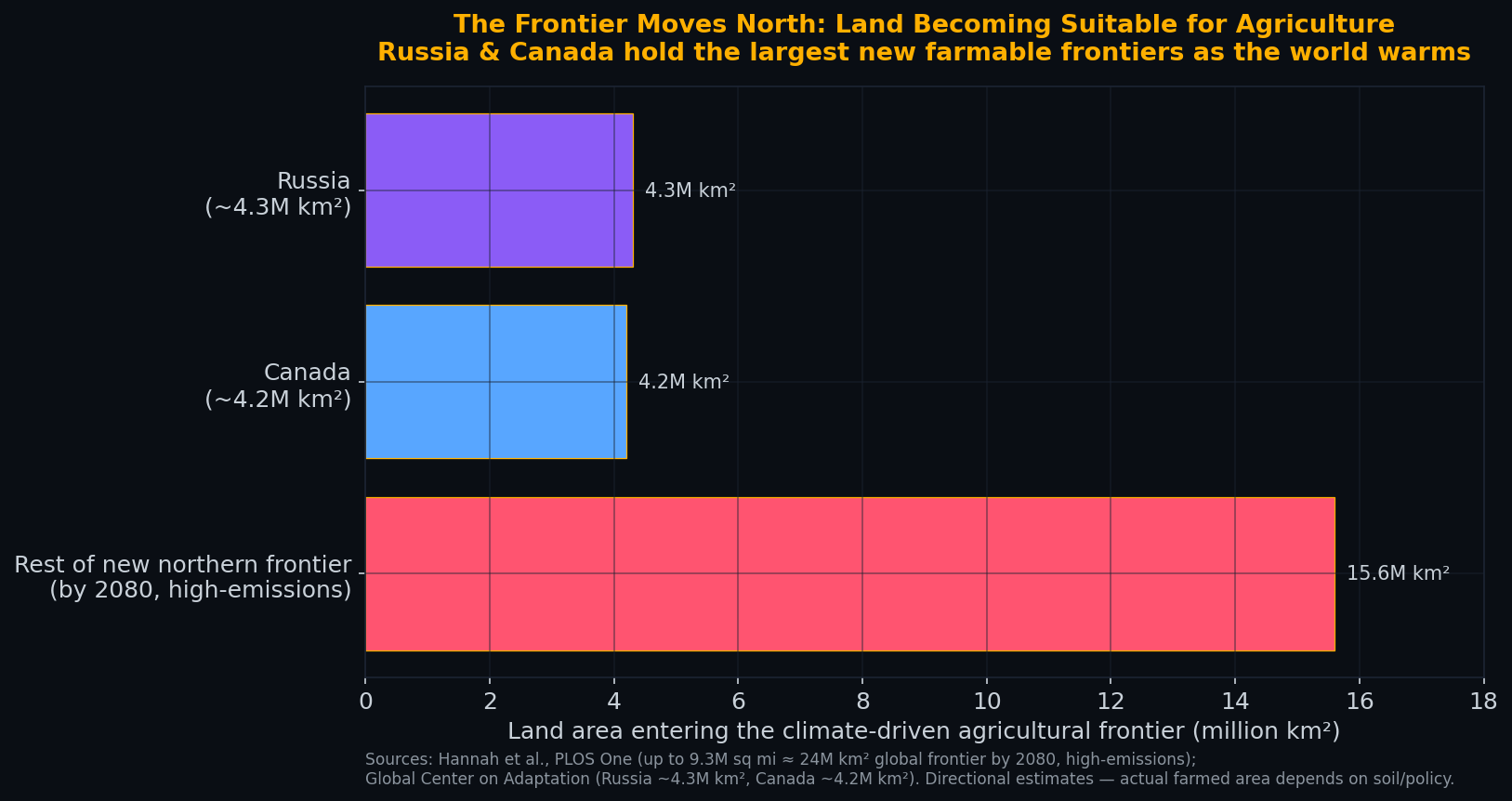
Modeled climatic suitability is not cultivated acreage. Soil, drainage, daylight, infrastructure, ecosystems, Indigenous rights, and permafrost determine what can actually be farmed.
The same study estimated that persistent permafrost-thaw disturbance could leave 29% of the lower-emissions frontier and 18% of the high-emissions frontier unsuitable [4]. A warmer growing season cannot manufacture topsoil, roads, grain terminals, or property rights.
This is where many Arctic theses fail: they convert temperature into acreage and acreage into revenue without pricing the intervening decades of capital and governance.
The Proxy Problem
Pure public-market exposure is weak.
Russian operators are sanctioned or inaccessible. U.S.-listed shipping funds are broad and thin. Home-market listings for major carriers are not Arctic pure plays. Defense and infrastructure contractors may win specific programs, but the work is distributed across diversified businesses and procurement cycles.
The liquid names most often attached to a “northern agriculture” thesis—Deere (DE), AGCO (AGCO), and VanEck Agribusiness ETF (MOO)—are imperfect proxies.
Deere sells large agricultural machinery and precision systems. AGCO offers equipment and mixed-fleet precision technology through brands including Fendt, Massey Ferguson, and PTx. Both could benefit from higher capital intensity in agriculture, but neither depends on Arctic acreage. Their filings make the real drivers explicit: crop prices, farm income, rates, credit, tariffs, inventories, and replacement cycles [5] [6].
MOO is broader still. It spans chemicals, animal health, fertilizer, seeds, machinery, aquaculture, plantations, and agricultural trading. That diversification reduces single-company risk and dilutes the thesis at the same time. It is an agribusiness basket, not a northern-land fund [7].
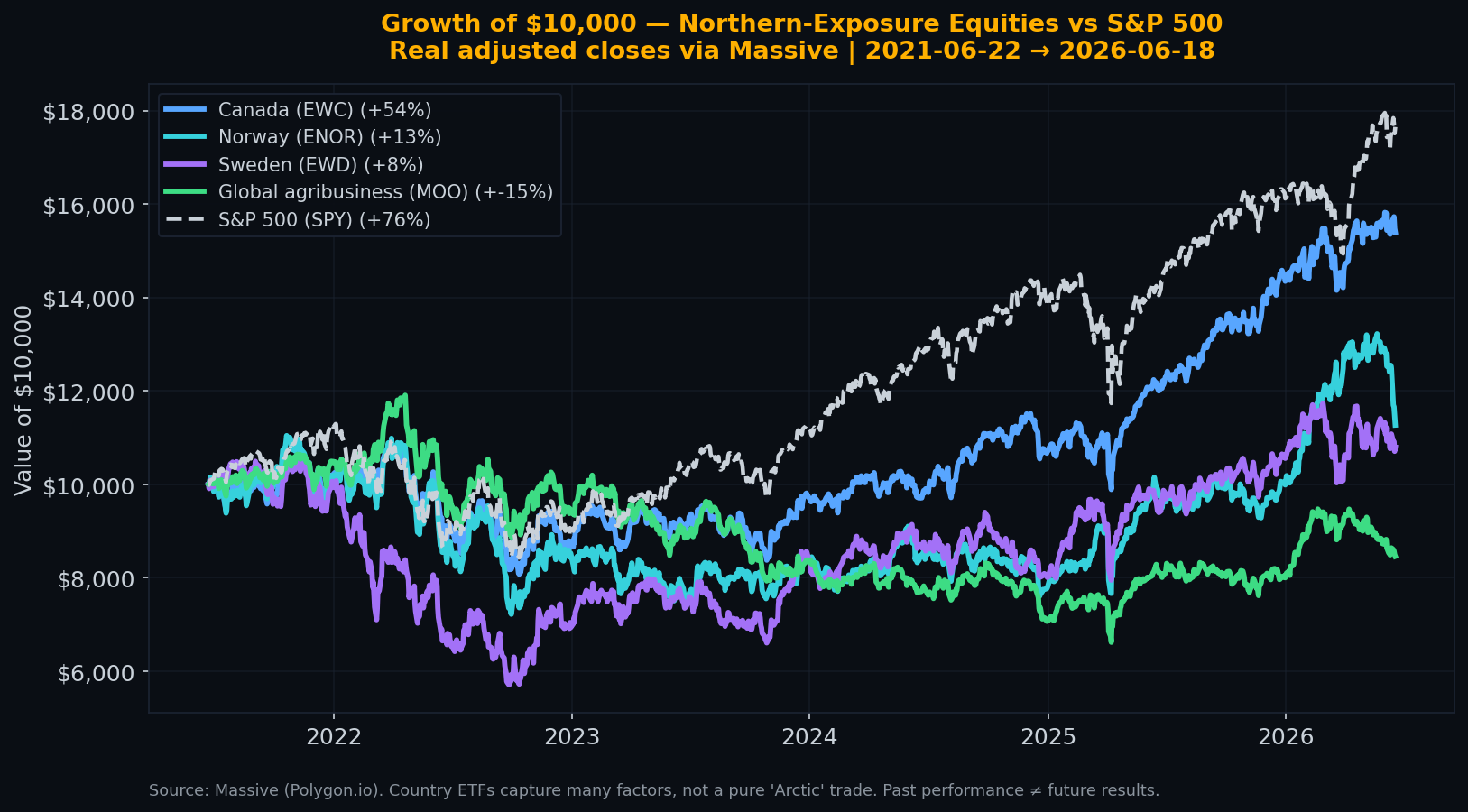
Historical performance illustrates the proxy problem: broad agribusiness and country exposure do not automatically monetize a physical Arctic shift.
The honest answer may be that the best Arctic asset is not yet publicly listed. Sometimes the graph reaches a terminal node before the market builds a security around it.
The Counterforces
The Arctic can become more accessible without becoming more profitable. Permafrost thaw damages foundations, roads, pipelines, and runways. A spill in cold, remote water is harder to contain. Ice-class vessels and insurance raise costs. Militarization can turn infrastructure into a security liability.
The climate path is uncertain too. Continued Atlantic Meridional Overturning Circulation weakening could cool parts of the Northern Hemisphere and expand regional sea ice in some model experiments. IPCC AR6 judged an abrupt collapse this century unlikely, but the low-probability regional consequences are large [8].
And the shipping emissions ledger is not automatically green: shorter distance can be offset by induced traffic, black carbon, ice-class fuel use, and infrastructure expansion.
The Arctic is therefore not a clean climate dividend. It is a contested adaptation zone.
Its value lies in the contradiction: more water becomes navigable, more land becomes climatically plausible, and more capital is required—just as the legal, political, and physical cost of operating there rises.
The map is opening. Ownership is not.
References
[2] NOAA, Arctic Report Card 2025 — Sea Ice
[3] Northern Sea Route operating data: Rosatom, “Northern Sea Route in the Spotlight” (route, 2024 traffic, and icebreaker fleet); Interfax quoting Rosatom CEO Alexei Likhachev (37.02 Mt total cargo in 2025); and Centre for High North Logistics, “Main Results of NSR Transit Navigation in 2025” (3.2 Mt transit cargo).
[5] Deere & Company, FY2025 Form 10-K and 2026 filings
[6] AGCO Corporation, 2025 Form 10-K
[7] VanEck, “Agribusiness ETF (MOO)” — strategy and disclosures
[8] “AMOC freshwater-hosing experiments,” Science Advances
This article is for informational and educational purposes only. It is not investment advice, a recommendation, or an offer to buy or sell any security. The author may hold positions in securities discussed. See the site’s full Disclaimer & Securities Disclosure.
Liquidity & size of the names above
Data as of 2026-06-26 · Massive/Polygon, last ~30 trading days · figures move daily
Real figures from market data (2026-06-23 (last ~30 trading days)). Size tiers reflect median daily dollar volume — how easily a position can actually be entered or exited. This is reference data, not a recommendation.
Liquidity, in plain terms: how easily you can get in and out. Deep means you can trade freely without moving the price; Thin means even small orders can move it — mind the spread.
What this does not tell you — valuation. A real structural deficit does not mean the price hasn’t already discounted it. These figures show size and tradeability only; we deliberately do not screen for valuation, solvency, or whether a name is cheap or expensive today. Do your own valuation work.
| Ticker | Name | Type | Market cap | Median daily $ vol | Liquidity |
|---|---|---|---|---|---|
| MOO | VanEck Agribusiness ETFDiversified agribusiness (equipment, fertilizer, seeds, processors); the low-effort way to own the northern-cropland leg. | ETF | n/a · ETF | $18.0M | Moderate |
| DE | Deere & CompanyDominant farm-equipment maker; direct leverage to expanding northern arable acreage. Cyclical to ag capex, not a pure 'Arctic' name. | Stock | $159.1B | $748.1M | Deep |
| AGCO | AGCO CorporationPure-play global farm-equipment maker (Fendt, Massey Ferguson); smaller, cleaner ag-equipment bet than Deere; more cyclical. | Stock | $8.2B | $72.7M | Liquid |
Tiers: Deep ≥ $100M/day · Liquid $20–100M · Moderate $3–20M · Thin $1–3M · < $1M = execution risk. The note under each name is a sourced exposure disclosure (how pure or diluted the play is), not a valuation view. Source: Massive/Polygon aggregates, last ~30 trading days (snapshot 2026-06-26). Figures move daily.
Found this useful? AtomProphet is independent and reader-funded — you can support the research & hosting ↓
Get the next cascade in your inbox
One short email when a new analysis drops — a single constraint traced end to end, from the physics to the chokepoint to the tickers, with the honest bear case kept in view. No marketing, no tracking, no noise.
- One email per published analysis — typically a few a month, never a daily blast
- The full cascade: driver → chokepoint → vetted, live-liquidity tickers
- The counter-case spelled out, not buried
No account, no paywall. Double opt-in, and one-click unsubscribe in every email.
Support the research & hosting
AtomProphet is independent, ad-light, and reader-funded. Contributions help cover data feeds, hosting, and the time behind the Cascade Graph — they keep this research free and open. A tip buys nothing, unlocks nothing, and is not payment for advice or for any security mentioned anywhere on this site.
Bitcoin37h98hpiHz6BW6ELvRLagk7BBo8UUtxeSh USDC · Base 0x1ac1Abe9eCAd5fAd8fF55B188E079b52cD1e6415